
There are two kinds of SMBs in Spain in 2026
Those with revenue and those with profit. The difference between them isn't the market, competition, or taxes. It's how they manage internally.
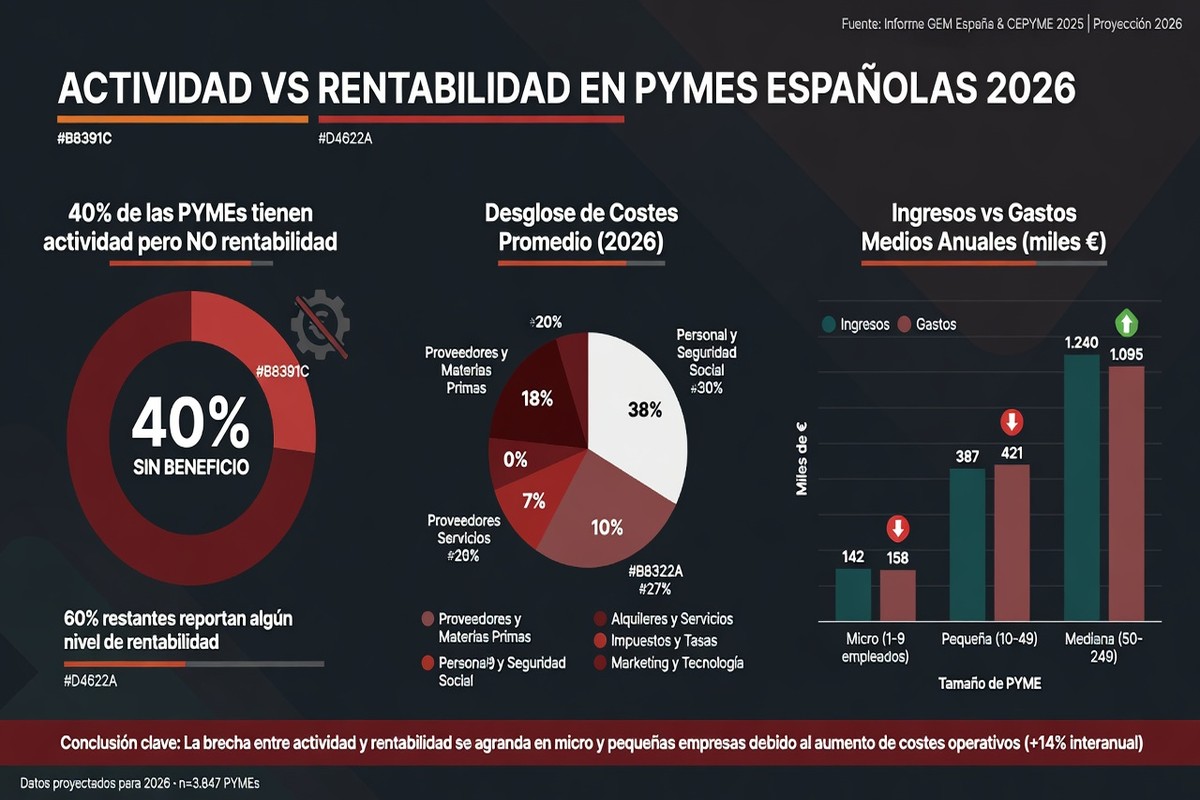
According to the Future Ready Business 2026 report from Wolters Kluwer, 40% of Spanish SMBs don't make money despite having sales. They invoice, have customers, move product or deliver service—but when you subtract all expenses, the number is negative or barely zero.
I've seen it a hundred times. You have an industrial SMB in Galicia, invoicing €200,000 a year, the workshop is packed, employees working flat out, and when you file your tax return or corporate tax, you realize there's barely anything left. Or worse: you're operating at a loss.
How is that possible? You have "success" on paper, but the business doesn't make enough to live on. Let's see why it happens and what you can do to fix it.
Why you invoice high but still have no money
I've talked to dozens of business owners. The pattern is always the same. Let's start with the obvious:
Your prices don't cover all your costs
Many freelancers and SMBs price like this: "What does it cost me to make this? Add 30% and done." The problem is that 30% only covers the direct cost, not everything else.
You need to pay electricity, rent, software, accounting, Social Security (yours and your employees'), computer maintenance, phone bills, insurance, taxes—without even counting your own time. If you don't build all that into your price, you're working for free.
A RevistaPYMES study found that 80% of SMBs spend 2–5 days a month just on admin work. Those are hours you're not invoicing but you're paying for anyway.
Bad digitalization is bleeding you dry
I see this a lot, especially in Galicia. 53.3% of accountants point to poorly executed digitalization as one of the main obstacles for SMBs.
What does "bad digitalization" mean? It means you bought software that doesn't fit your business, you have five different tools that don't talk to each other, and at the end of the day you're still doing the same work—just with more digital admin.
It's not a lack of digitalization. It's bad digitalization. And it costs you real money every month in subscriptions you don't use and time you waste trying to figure out how things work.
"The most expensive mistake isn't failing to go digital. It's going digital wrong—with tools you don't understand and that don't fit how you actually work."
BigLobster team, after analyzing dozens of Galician SMBsThe true cost of employees (which you don't see until you calculate profit)
Hiring someone costs more than just their salary. The real cost of an employee is their gross salary plus Social Security (roughly 30–40% on top of gross) plus office space, materials, training, and everything else.
If you've read our article on what it costs to hire someone in 2026, you know that hiring one person can run €35,000–50,000 per year when you count everything. If that person doesn't generate at least that much in net profit, they're costing you money every month.
Stop invoicing for the sake of invoicing—start making real profit
I'm not going to hand you textbook management advice. I'm going to tell you what actually works for real SMBs: those with shops, warehouses, and zero patience for nonsense.
Do the real math, not the guesswork
Pull up a spreadsheet (or better yet, use a real ERP) and list every expense you have each month. When I say every expense, I mean it: from coffee out of the machine to the workshop electricity bill. Then divide those costs by the number of projects or services you deliver each month.
That gives you your "cost per unit." If you're selling below that, you're losing money even though the customer is paying and everything looks okay.
Raise your prices (yes, you'll lose some clients)
Most SMBs have had the same prices for years. If your costs have gone up (and they have, with inflation), your prices need to go up too. Don't spike them all at once, but do adjust at least 5–10% every year.
The clients who leave over a reasonable price increase weren't good clients anyway. Good clients value your work and understand that costs go up for everyone.
Use tools that actually integrate
If you're using one brand's CRM, another's invoicing software, and inventory in an Excel you update by hand, you're losing hours every week. Those hours are money.
Platforms like Odoo or ERPNext integrate everything. Or if you prefer something more modular, use automation with tools like n8n to connect your systems. The time you save is time you can invoice or just take off.
Automate what repeats (stop doing what a robot could do)
How many hours a week do you lose sending invoices, answering repetitive emails, or updating inventory? Probably several. If you invoice €50 an hour, those hours cost you real money.
With AI and automation, you can have an AI agent managing your receivables, alerting you to unpaid invoices, or even handling customer support. You don't need to know how to code—just be willing to stop doing repetitive work.
Real digitalization means doing less, not more
Proper digitalization means fewer things to do, not more. If after going digital you're still checking more screens, confirming more things, and doing the same work, you did it wrong.
The Cosmomedia report on 2026 digitalization trends says AI is no longer abstract. 76% of Spanish SMBs use AI solutions at least once a week. But pay attention: using AI doesn't mean having a chatbot nobody touches. It means AI helps you invoice more or spend less time on busy work.
At BigLobster we build AI agents for SMBs that do exactly that: they cut out the tasks that drain your time and money. From collecting invoices to managing inventory or handling the customer who always asks the same question.
Frequently asked questions
Why does my SMB have sales but lose money?
Most common causes are hidden costs: hours you don't invoice, admin expenses that slip through the cracks, or prices that don't cover all your real costs. According to Wolters Kluwer's Future Ready Business 2026 report, 40% of Spanish SMBs are in this situation. Do the real math and you'll see where your money goes.
How do I know if my SMB is actually profitable?
Subtract all your real costs (including your time and Social Security) from your revenue. If the number is negative or barely positive, you're not profitable even if you're invoicing a lot. A proper ERP will give you these numbers in real time if you set it up correctly.
How long can I keep going without being profitable?
Depends on your cash reserves, but generally a non-profitable SMB starts to struggle after 6–12 months. Chronic losses prevent you from investing in better equipment, training, or real growth. You end up working harder for less money, and that's not sustainable.
Will automation actually make me more profitable?
Yes, if you automate the right things. Automating repetitive tasks saves you hours each week. If you invoice at €50/hour and save 10 hours a month, that's €500 in extra profit. That's not counting the fact that you're rested and can focus on work that actually creates value.
Is it worth hiring an accountant to help with this?
Absolutely. A good accountant doesn't just handle paperwork—they help you see where you're losing money. Accountants surveyed in spring 2026 noted lack of institutional support and excessive regulation as problems, but they can help you cut costs if you know what to ask.
Your SMB has revenue but no profit?
Let's talk. We help you find where your money is leaking and automate what's eating your time. No BS, no smoke—just real data from your business.
I'm ready to stop losing money