What's actually changing (and what isn't)
Law 31/1995 has remained essentially unchanged for thirty years. In that time, your shop has upgraded machinery twice or three times, you've replaced filing cabinets with software, and someone in your engineering office now works remotely. The law, meanwhile, was still written for 1995.
That ends now. On February 10, 2026, the government and unions signed the agreement. On March 16, the draft was published, and the Cabinet has now approved it. Note the distinction: it's not law yet. It must pass through Parliament, and the text could change. But the draft itself targets January 2, 2027 for most obligations, with technical training timelines extending to 2028.
Does that mean you can sit tight until December? You could. But if you're managing workplace safety with Excel and shared folders, what's coming will catch you off guard. And fines for serious safety violations under Spanish labor law range from €2,451 to €49,180 per infraction.
Psychosocial hazards are no longer just a "big company" issue
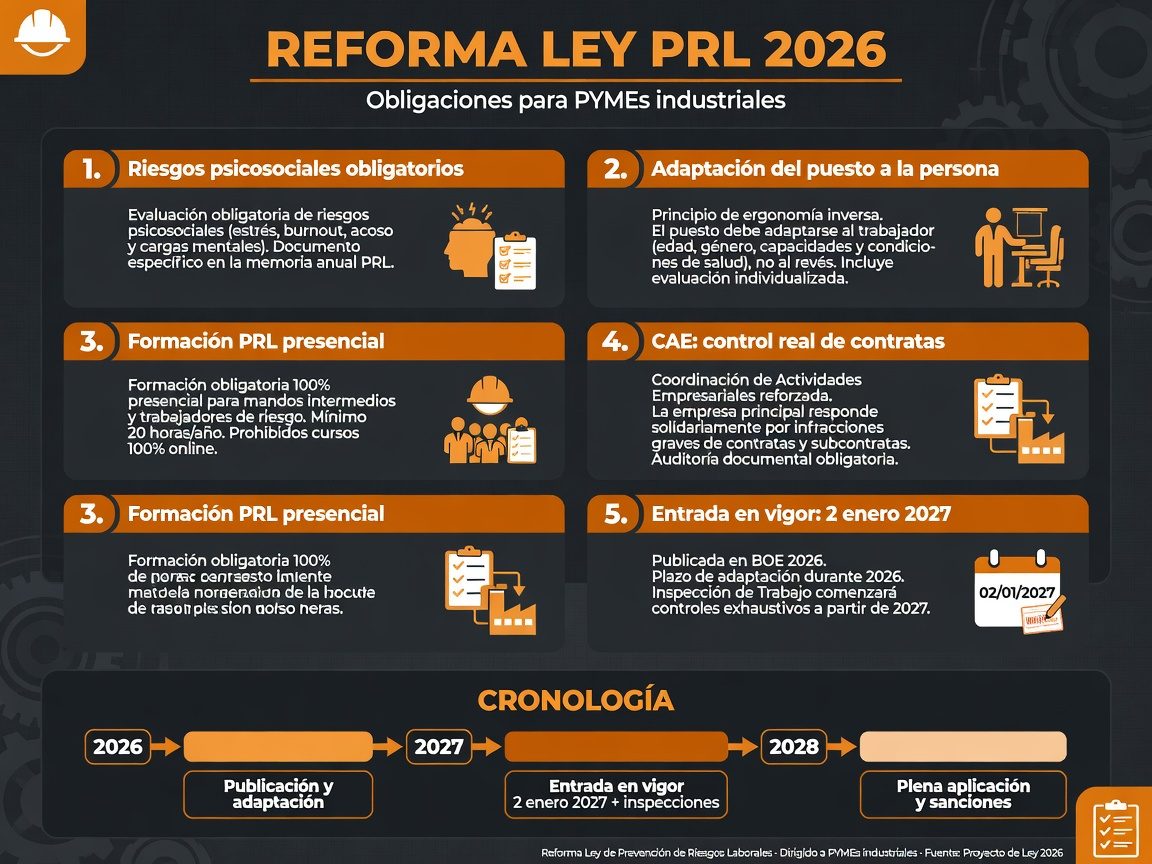
This is the core change. The reform expands the definition of workplace harm: it's no longer limited to physical injury. Stress, workload, burnout, role ambiguity, pace imposed by systems or algorithms—all of this becomes mandatory risk assessment, at the same level as noise or chemical exposure.
In an industrial SMB this sounds abstract until you make it concrete. Do you have a supervisor who becomes a bottleneck because everything flows through them? Shifts that change on Friday for Monday? An admin person juggling orders, invoices, and customer complaints simultaneously? Under the new law, that's assessable and manageable risk. And if someone takes leave due to anxiety and you haven't done the assessment, that's on you.
I won't sugarcoat it: assessing psychosocial hazards well is harder than measuring decibels. But here's a positive angle almost nobody mentions: many of the causes (overload, repetitive tasks, constant interruptions) are solved by automation. Removing 15 hours per week of mechanical work from someone's plate isn't just productivity—starting in 2027, it's also documented prevention.
Contractor oversight moves beyond PDF checklists
If you work for tier-1 automotive, food, or construction suppliers, you know the drill: upload medical clearances, training certificates, and insurance to whatever platform each client demands. The reform directly targets the broken part of that system: document filing nobody actually verifies.
Three concrete shifts:
- Real oversight, not paperwork. The prime contractor must now verify actual compliance from subcontractors and sub-subcontractors, not just file their certificates.
- Freelancers under scrutiny. Explicit duty to monitor when you contract self-employed workers for risky tasks at your site, even if it's not your core business.
- Contractor regulations updated. The regulation governing contractor coordination will be updated within a year of the law taking effect.
Practical translation: if you're a contractor, your large clients will demand more documentation, more current, and faster. And if you sub-contract (maintenance, industrial cleaning, transport), your responsibility to monitor goes up a level. Excel and email don't scale this. According to the sector, 67% of labor inspections already cite expired or missing safety documentation; with the bar higher, that number only rises for anyone still using paper.
In-person training and individualized job accommodation
Two more changes that directly hit manufacturing:
Hands-on training becomes mandatory. No more checking the box with a 20-minute online course someone clicks through at breakfast. You'll need to schedule actual training sessions, manage production line coverage, and document attendance. It's more expensive to organize, and it's also harder to fake during an inspection.
Jobs must be adapted to the person, not the reverse. PPE must fit each worker (sizes, gender, age), return-to-work after extended leave requires a plan, and managing age diversity on the shop floor is now a detailed obligation. In a sector where average employee age keeps rising, this isn't theory—it's your floor.
Add to this the requirement for active protocols against harassment, including digital environments and misuse of AI. Having a dusty document in a drawer won't work; you'll need to demonstrate the protocol actually functions.
What I'd do if I ran an industrial SMB right now
The temptation is to wait for the law to pass. Don't. Everything the draft requires is reasonable to do now, and adaptation timelines are tight. Here's my priority order:
- Digitize safety documentation this year. Medical clearances, training records, PPE distribution, all with expiration alerts. It's the cheapest fix and prevents the most fines. Tools for SMBs start below €40/month.
- Talk to your occupational health service and directly ask how they'll approach psychosocial assessment. If they dodge the question, start comparing providers.
- Map your regular contractors and freelancers. Who enters your site, what they do, what documentation they have. That map becomes the foundation for upgraded contractor oversight.
- Automate what creates workload overload. Paper logs, duplicate data entry, chasing shipping docs over WhatsApp. Less psychosocial risk, plus documented evidence for your assessment.
- Budget in-person training for 2027 in your fall planning now, accounting for production downtime.
If you're also applying for digitalization grants, check our guide to digital transformation grants in Galicia: some of this safety digitalization is grant-eligible.
The angle nobody talks about: safety as data
Most SMBs treat workplace safety as a compliance burden. Look at what the reform actually demands at its core: traceability. Who did which training, when does which clearance expire, which contractor entered the site which day, was the corrective action closed on time. That's exactly the same type of data you already manage (or should) in OEE, in digital work orders, or in your ERP.
Companies that integrate safety into their data systems instead of treating it as a separate filing cabinet will achieve compliance almost without extra effort. Those still using paper will pay twice: in administrative hours and in stress from inspections. There's documented correlation between serious prevention programs and financial return: fewer absences, lower insurance premiums (a serious accident can raise your premiums 10–50% for years), and stronger standing with tier-1 clients who audit their suppliers.
Frequently asked questions
Is the new Workplace Safety Law in effect now?
No. What's been approved is the draft. It must go through Parliament and could change. The effective date stated in the draft is January 2, 2027, with technical training adaptations extending into early 2028.
Does it apply the same way to a 12-person SMB and a large firm?
The new obligations (psychosocial assessment, job accommodation, harassment protocols, strengthened contractor oversight) apply to all companies. The draft includes support measures for SMBs like regional safety advisors and training subsidies, but no substantive exemptions.
Can I keep managing safety with Excel?
Legally, nobody forces you to use software. In practice, with stricter contractor oversight, in-person training deadlines, and the traceability inspectors will demand, Excel becomes your weak point. Fines for expired or missing documentation run €2,451 to €49,180 per serious violation.
What about freelancers working at my site?
The reform introduces an explicit duty to monitor when you contract self-employed workers for risky work at your facility, regardless of whether that's your company's main activity. You'll need to document that you actually verified their compliance, not just that you asked for a certificate.
Do psychosocial hazards apply on a shop floor, or just in offices?
They apply everywhere. Production surges, poorly scheduled shifts, deadline pressure, or pace set by machines and systems are all assessable psychosocial risks in manufacturing. Actually, industrial settings are where they weigh most heavily.
Is safety eating up your admin hours?
At BigLobster we automate the heavy lifting: documentation with alerts, digital logs, data connected to your ERP. Tell us how you're managing it today, and we'll show you what you can get off your plate.
Talk to BigLobster →